Urban for institutions
Positioning
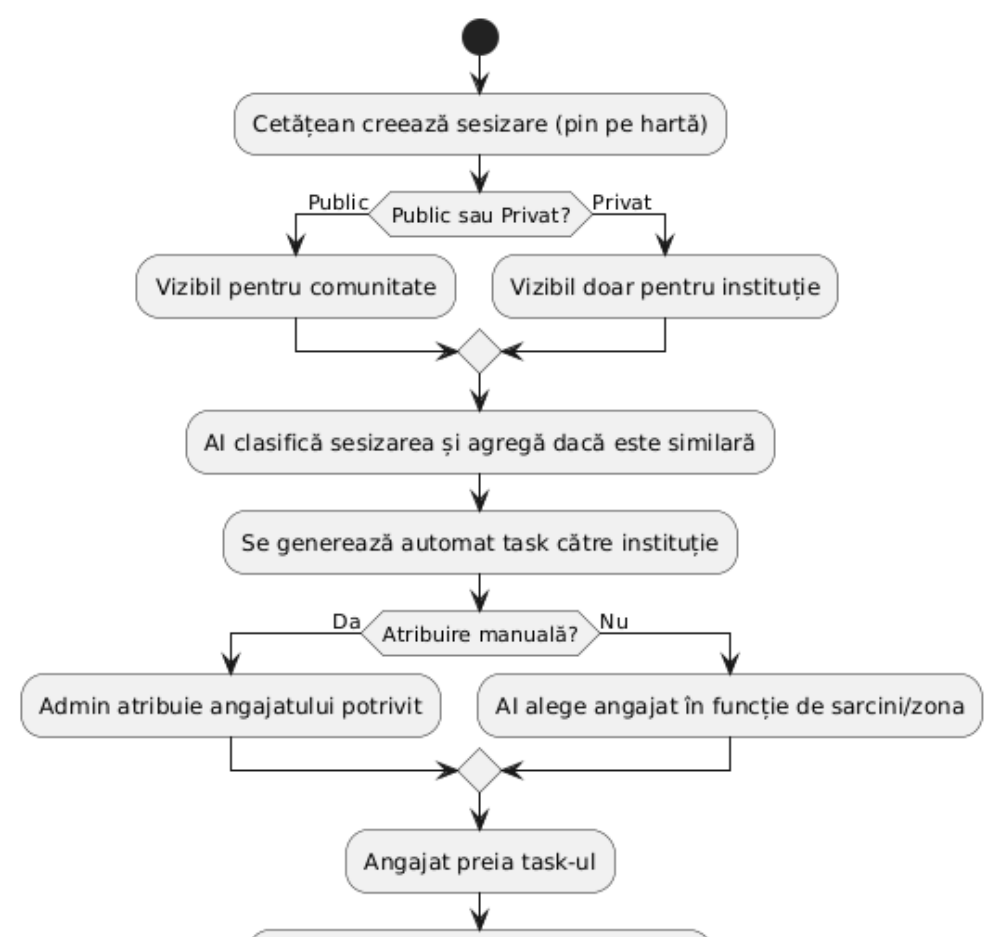
.Urban is not a classic city reporting application. It is an operational system through which an institution can take community signals and transform them into a coherent flow of sorting, allocation, execution, communication and reporting.
In short, it doesn't just digitize the notification. It digitizes the complete path of the problem, from the citizen to the team that solves it.
Why it is superior to a classic city application
A classic city application collects notifications.
.Urban does more:
identifies the relevant institution according to location and jurisdiction;
transforms the public report into an internal operational object;
reflects the real structure of the institution through roles, departments, teams and privileges;
allows the allocation and tracking of tasks in the same flow;
offers a public framework for interaction, consultation and institutional presence;
helps management see not only the volume of notifications, but also the operational progress.
What the institution gains
Less administrative chaos: complaints are directed more correctly and reach the right structure more easily.
More operational efficiency: the report is not lost between the front office, coordination and the field.
More managerial control: the management sees what comes in, what is allocated, what stagnates and what is resolved.
More transparency with internal control: the citizen sees progress, and the institution maintains its operational discipline.
More public trust: the institution no longer seems like a simple recipient of complaints, but an active and organized actor.
What the citizen gains
sends the complaint more easily to the right institution;
enters a clearer and more credible flow of resolution;
sees a more present, more coherent and more modern institution;
interacts not just with a form, but with a system that gives the impression of a real response.
Key Differentiators
Territorial Routing: The correct institution is determined based on area and jurisdiction.
Report -> task continuity: the notification is not disconnected from execution.
Real internal organization: dynamic roles, departments, teams, members, secure invitations.
Field coordination: tasks with context, location, media, comments and status.
Modern institutional relationship: public profile, surveys, mentions, appreciations, petitions for uncovered areas.
Gradual implementation: the institution can start with a small pilot and gradually expand.
Why it is a justified investment
.Urban can be presented as an investment in the operational capacity of the institution, not as a simple cost of digital communication.
Its value comes from the combination of:
reducing administrative friction;
increasing the speed of reaction;
better traceability and accountability;
clearer managerial visibility;
healthier relationship with the community.
In conclusion
A classic city application helps the citizen to submit a problem.
.Urban helps the institution to take it, organize it, allocate it, solve it and publicly demonstrate that it works.